



The observation grid for a field sales meeting
Sixteen sequences weighted to one hundred, each carrying the field benchmark that says what good looks like. It scores itself, it prints on a single landscape page, and every line asks for a timestamped verbatim instead of an opinion. Free, in French and English.
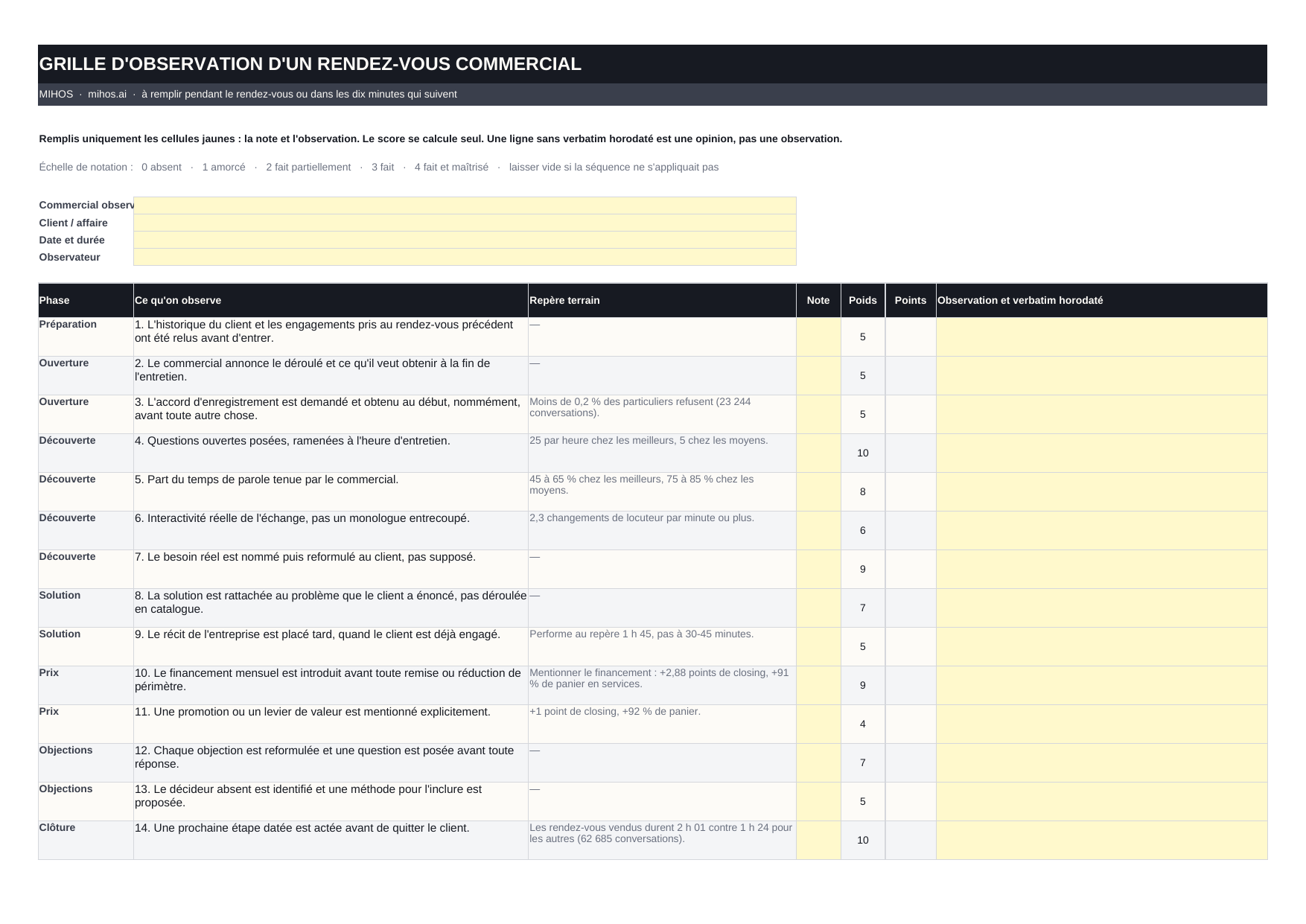
Most of the sales-meeting grids in circulation ask a manager to rate listening, or attitude, out of five. That is an opinion with a number stapled to it, and the rep knows it. This one asks for two things instead: a benchmark to score against, and a timestamped verbatim on every line.
What is in it
One landscape page, sixteen sequences, weighted to a hundred. The score is computed from the sequences you actually rated, so a grid filled in for half a meeting still returns a number that means something. Leave a line blank when the sequence did not apply and the weighting adjusts itself.
- Preparation, opening and consent, discovery, solution, price and financing, objections, close, and the human part.
- A field benchmark on every line where one exists: open questions per hour, share of talk time, speaker changes per minute, where the company story belongs in a long meeting.
- A verbatim column, because a line without a timestamp is not an observation, it is a recollection.
- A second sheet listing every benchmark and the base it was measured on.
- Three focus points for the next meeting. Three, never ten.
Where the benchmarks come from
The figures beside the sequences are a public field-sales industry benchmark published by Rilla Labs across more than a million analysed conversations. They are not MIHOS results and they are not a law of nature. They are an order of magnitude, which is useful mainly because most managers have never had one.
Your own team is the benchmark that finally matters. The published figures are there so the first conversation has somewhere to start.
How to use it without ruining the meeting
Fill it during the meeting if you can write without looking up, and within ten minutes of leaving if you cannot. Later than that and you are grading a story you have already rewritten.
Hand the completed grid to the rep before you discuss it, and let them speak first. A manager who opens the debrief gets a rep who defends themselves.
Sales meeting observation grid
XLSX, four sheets: the grid and its benchmarks in French, then the same in English. Sixteen weighted sequences, and a score that computes itself. The download starts the moment you submit.
What a paper grid cannot do
It only exists when a manager is in the room. Four ride-along days a month means four meetings observed out of the several hundred a team holds, and the fifteen you would most want to see are never the ones you attended.
MIHOS fills the same grid on every meeting, from what was actually said, and makes each score clickable through to the timestamped verbatim behind it. The grid stops being a manager's impression and becomes the record.
Sources
Rilla Labs field-sales benchmark: talk time, open questions, speaking pace and interactivity across more than one million analysed conversations; process adherence across 38,470 appointments in 46 companies; meeting duration across 62,685 conversations; consumer refusal to be recorded across 23,244 conversations. A public industry benchmark, not a MIHOS performance claim. Figures are orders of magnitude and are not a substitute for measuring your own team.
Read next