



The ride-along form, and the three rules that make it work
What a manager writes down while sitting in on a rep's customer meeting: a timed record of what happened, the sequences that were covered, a debrief run in the right order, and three focus points with a review date. Free, in French and English.
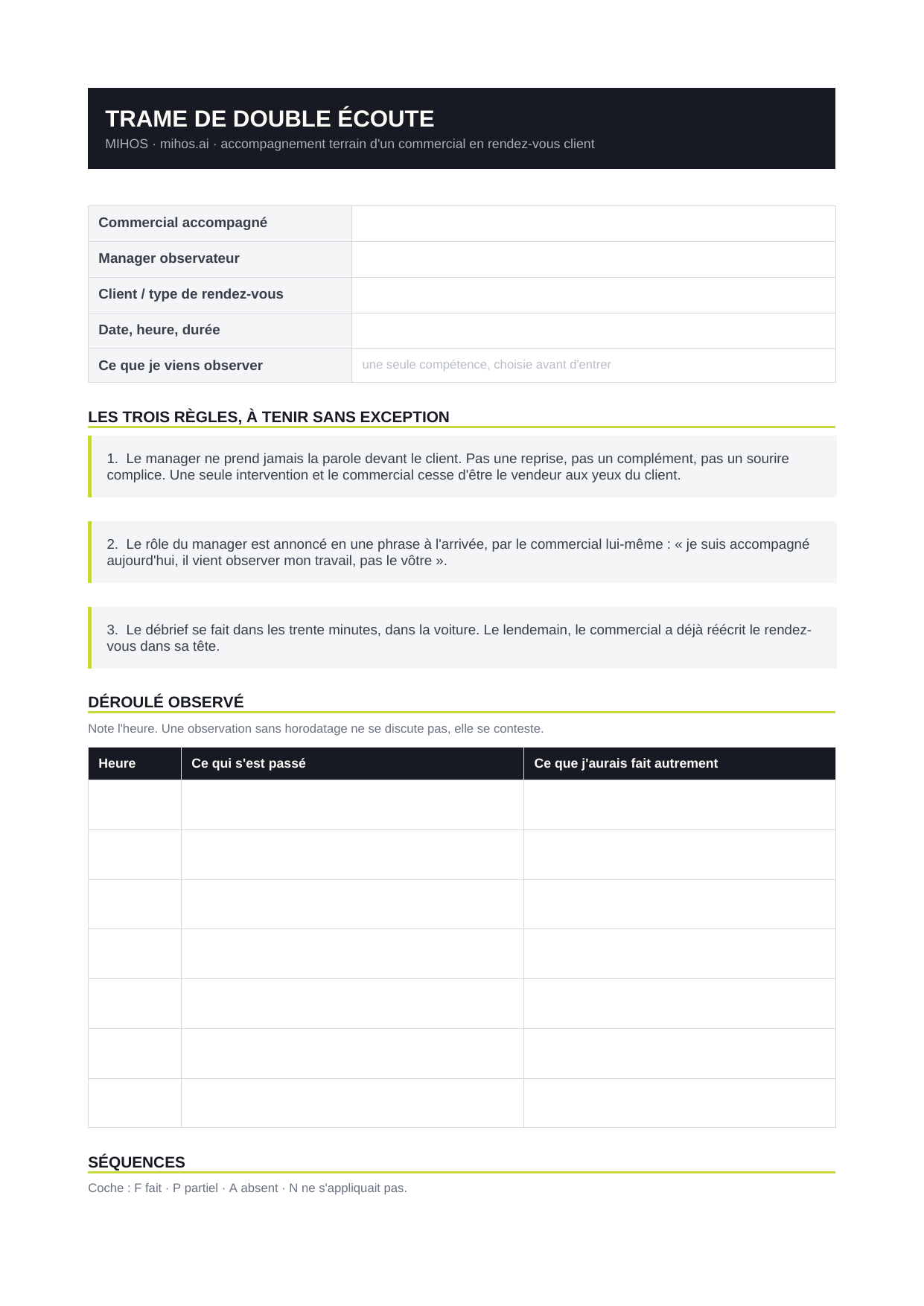
Sitting in on a rep's meeting is the oldest coaching tool in field sales and the easiest one to ruin. Two mistakes account for most of it: the manager speaks in front of the customer, and the debrief happens the next day. Both are avoidable, and neither has anything to do with the form.
The three rules
The manager never speaks in front of the customer. Not a correction, not a helpful addition, not a knowing look at the right moment. One intervention and the rep stops being the seller in the customer's eyes, which means you are no longer observing the meeting they would have had.
The manager's presence is explained in one sentence, on arrival, by the rep: a colleague is here to observe my work, not yours. Said plainly it costs nothing. Left unsaid it sits in the room for an hour.
The debrief happens within thirty minutes, in the car. By the next morning the rep has already rewritten the meeting into a version where the objection was unanswerable and the customer was never going to buy.
What is on the form
- The one skill you came to observe, chosen before walking in. Observing everything means noticing nothing.
- A timed record: what happened, and what you would have done differently. Timestamps make an observation discussable instead of disputable.
- Ten sequences to tick as done, partial, absent, or not applicable.
- The debrief in three moves: what they think they did well, what they would change, what you saw that they did not.
- Three focus points, each with how you will both know it is there, and a date to review it.
- The date of the next ride-along, set before you get out of the car.
The arithmetic nobody says out loud
A manager who protects four days a month for ride-alongs observes maybe eight meetings. A team of eight reps holds several hundred in the same month. So the coaching covers two or three per cent of what happened, chosen by diary availability rather than by need, and the meetings you would most want to have seen are the ones you were not in.
That is not a criticism of ride-alongs. It is the reason they cannot be the whole system.
Field ride-along form
DOCX, two pages in French then the same two in English. The three rules, a timed record, ten sequences, the debrief order and three dated focus points. The download starts the moment you submit.
What the form cannot reach
Everything that happened when you were not there, which is almost everything. And the meetings a manager attends are, by construction, the ones the rep was most prepared for.
MIHOS runs the same observation on every meeting the team holds, scores it against your own playbook, and takes the debrief straight to the minute the objection landed. The ride-along stops being the coaching system and becomes what it should be: the day you go and see for yourself.
Notes
This form is ours, built from how field sales managers in home improvement, energy, HVAC, automotive, security and insurance actually run a ride-along. Take it, change it, put your own name on it. The three rules are the part worth keeping intact.
Read next